The Sensor That Stopped Reporting — and Nobody Noticed for Eleven Weeks
Most FSMA 204 compliance roadmaps start and end at software. The failures start at the physical layer.

A cold storage facility in the Pacific Northwest runs a traceability platform that costs six figures a year. The dashboard is green. Every sensor location shows a status indicator. The compliance team exports monthly reports showing 99.7% data capture across all monitoring points.
What nobody notices: three sensors in the blast freezer stopped transmitting eleven weeks ago. The platform does not distinguish between “no data because nothing happened” and “no data because the sensor is dead.” Those three monitoring points sit in the dashboard like unplugged security cameras — present in the interface, absent from the record.
This is the FSMA 204 hardware gap — the disconnect between what traceability software reports and what physical sensors actually capture. The FDA’s Food Traceability Final Rule requires Key Data Elements at every Critical Tracking Event. The enforcement deadline, now pushed to July 20, 2028, has not changed the requirements — only extended the runway. And most of that runway is being spent evaluating software platforms, not testing whether sensors survive the environments where data originates.
Two decades of IoT hardware engineering across 100+ countries and 42+ cold chain device architectures reveal a consistent pattern: compliance failures start at the physical layer, not the application layer.
The Five Silent Failures
What makes hardware failure so dangerous for compliance is that it is invisible to the software layer. A sensor that dies in a -30°C freezer does not send an error message. It simply stops. The traceability platform has no way to know the difference between an empty zone and a dead device.
Five failure modes account for the vast majority of hardware-layer compliance gaps:
1. Environmental kill. A sensor rated IP65 survives lab testing but not the daily high-pressure wash-down in a food processing facility. Water ingress corrodes the PCB over weeks. By the time the sensor fails completely, the data gap extends months into the past. The minimum viable rating for food environments is IP67; facilities running CIP/SIP cycles need IP69K.
2. Battery death in deep cold. Standard Li-ion batteries lose capacity rapidly below -20°C and can experience voltage collapse at -25°C. A sensor deployed in a blast freezer with a Li-ion battery will fail within months — silently. Lithium thionyl chloride (LiSOCl₂) cells operate down to -55°C with less than 1% annual self-discharge. The chemistry selection determines whether a sensor lasts six months or ten years.
3. Connectivity blackouts. Metal warehouse racking, insulated cold room walls, and reefer containers act as Faraday cages. A sensor relying on real-time cellular or Wi-Fi connectivity will have reporting gaps in exactly the environments where FSMA 204 data is most critical. Without store-and-forward capability — the ability to buffer readings locally and transmit when signal returns — every RF blackout becomes a compliance blackout.
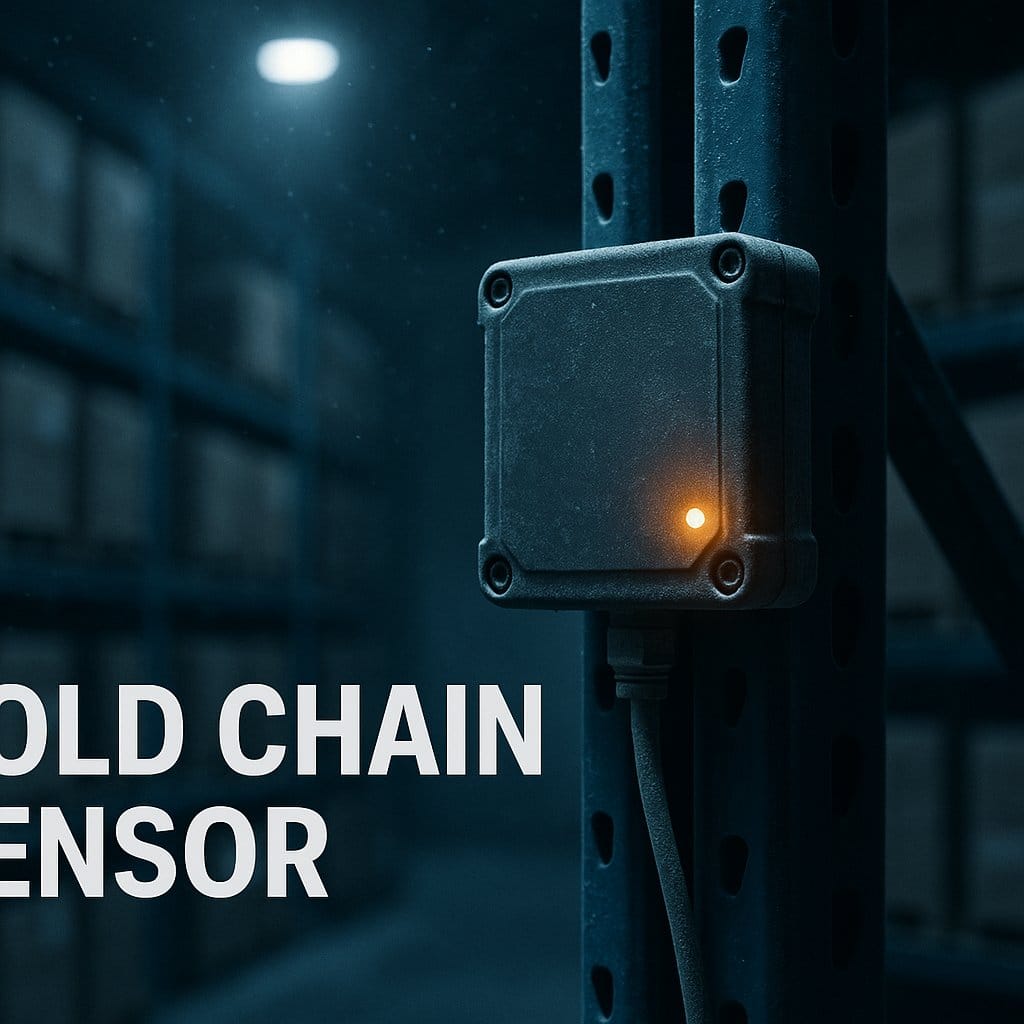
4. Lot-code timing gaps. FSMA 204 requires Traceability Lot Codes at every Critical Tracking Event. Most implementations bind sensor readings to lot codes in software, retrospectively. If the sensor reads temperature at 14:32 and the WMS assigns the lot code at 15:15, there is a 43-minute window where the data association is assumed, not recorded. Hardware-level binding — through barcode scanning or BLE beacon pairing at the moment of the event — eliminates this ambiguity.
5. TCO surprise. The purchase price of a cold chain sensor is typically 15–25% of its three-year total cost of ownership. Installation, connectivity fees, battery replacements, calibration, and health monitoring make up the rest. Organizations that select sensors on unit price often end up with the highest three-year cost — because $45 devices that fail every 18 months cost more than $120 devices that last five years.
A traceability platform is only as reliable as the least robust sensor in the chain. Software cannot compensate for hardware that fails to generate data.
The 30-Month Window Is a Hardware Window
The FDA’s decision to extend the FSMA 204 deadline by 30 months was an explicit acknowledgment that the industry’s physical infrastructure was not ready. The agency’s own language pointed to coordination challenges across supply chain partners — which is another way of saying the hardware layer across thousands of facilities is not interoperable, not tested, and not deployed.
Yet most organizations are using the extension to evaluate software platforms. The hardware evaluation — sensor pilots in real operating conditions, battery survival testing in actual freezer environments, connectivity mapping in real warehouse layouts — is being deferred to the final months before the July 2028 deadline. That is the exact pattern that created the readiness gap the extension was meant to solve.
A proper sensor pilot takes 90–180 days in the harshest facility conditions. It reveals battery degradation curves, connectivity dead zones, and environmental failure modes that no datasheet predicts. Starting that pilot in Q1 2028 leaves no margin for the redesign cycle that the pilot is designed to inform.
What This Means for Compliance Teams
The organizations that will be ready for July 2028 are the ones treating the extension as a hardware deployment window, not a software evaluation window. The software decision is important, but it is downstream. The platform cannot compensate for sensors that do not survive, do not connect, and do not bind to lot codes at the right moment.
The hardware layer does not demo well. It is not a feature announcement or a dashboard screenshot. But it is where traceability data is born — and where most compliance failures quietly begin.
What hardware questions have come up in your own FSMA 204 planning? Reach out — always curious what surprises have emerged in the field.
This article was written with AI assistance for research and drafting.